Field notes · 13 October 2026
Bare peat vs vegetated peat: how to tell them apart in satellite imagery
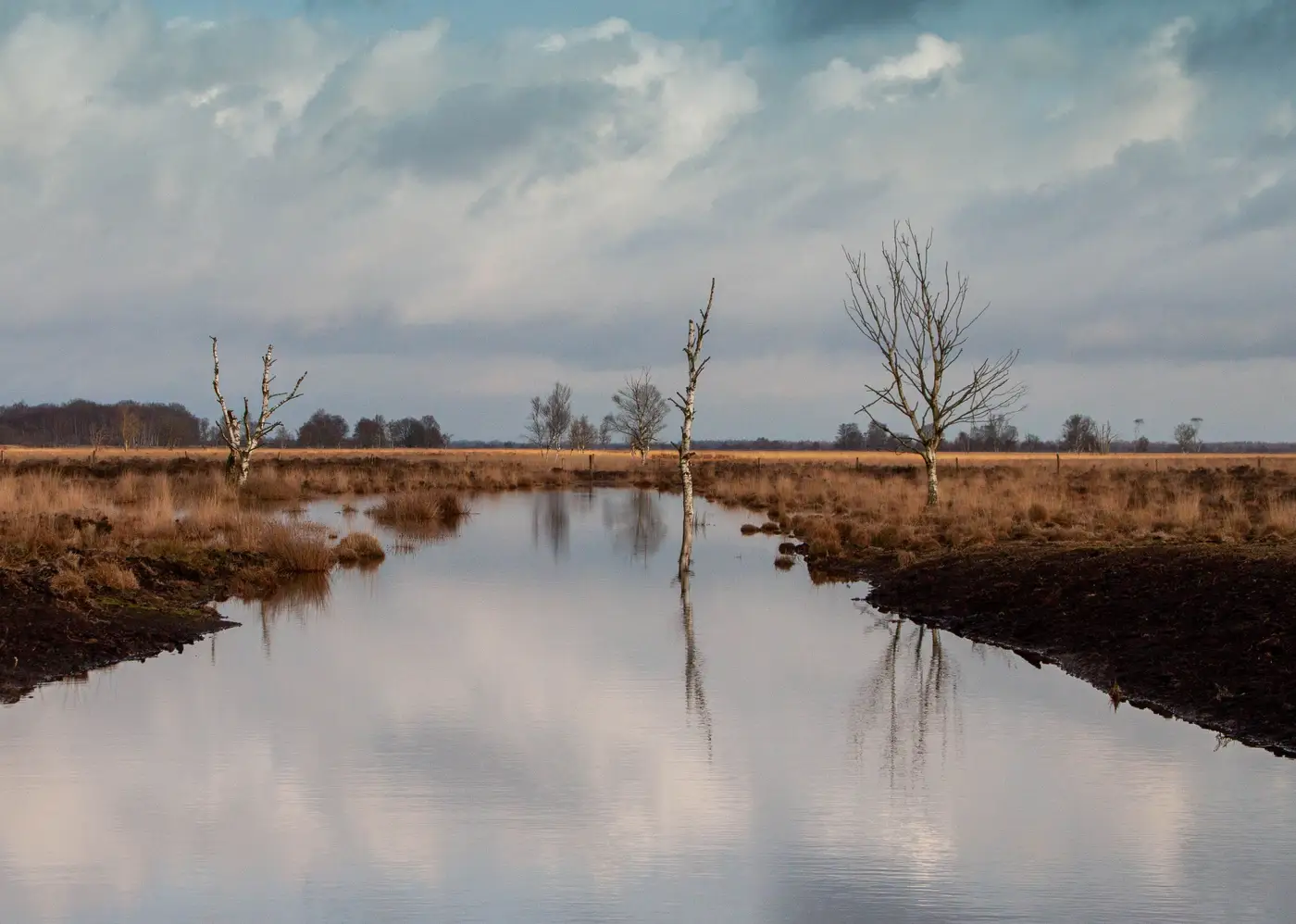
If you manage a funded restoration area, bare peat exposure is the line item everyone wants a straight answer on. Peat that's lost its vegetation cover, whether from drainage, burning, trampling or eroding hag edges, keeps oxidising and releasing carbon long after the funder's logframe assumed it would be stabilising. Vegetated peat, by contrast, holds moisture at the surface and slows that process down. Telling the two apart in imagery sounds simple until you've tried to sort one from the other on a scene with a mix of bare ground, dead Molinia, charred stubble and standing water all sitting within a few pixels of each other.
What the spectral signature shows
Healthy peat vegetation, sphagnum, cotton grass, heather, reflects strongly in the near-infrared and absorbs red light for photosynthesis. That gives it the high NDVI you'd expect from any living canopy. Bare peat has a flatter spectral curve across the visible and near-infrared bands. It's darker overall, more reflective in the red than live vegetation, and it doesn't show the chlorophyll dip that living plant material does. In practice that means a patch of exposed peat reads as a low, flat signature where a vegetated patch reads as a sharp contrast between red and near-infrared.
That's the clean case. The field case is messier.
What confuses the classification
A few things routinely trip up a straightforward bare-vs-vegetated read:
Burnt ground can look spectrally close to exposed peat in the weeks after a fire, but char and bare peat soil behave differently over the following seasons. One recovers vegetation cover on a fairly predictable trajectory; the other, if drainage is still active underneath, often doesn't.
Bog pools and standing water read darker than bare peat in most bands, and on a single scene a wet bare peat flat and open water can blur together, especially at coarser resolution.
Senescent vegetation is the quiet one. Dead Molinia grass in late autumn drops NDVI sharply even though the ground isn't bare, it's just not photosynthesising that month. A single autumn scene can flag ground as newly exposed peat when it's just dormant grassland cover.
Shadow along gully walls and hag faces reads dark too, and on steep eroding edges that shadow can look a lot like bare substrate from directly overhead.
Why one scene isn't enough
Comparing the same ground across multiple dates clears up most of this confusion, more reliably than any single-date index can. Genuine bare peat persists: it's dark and flat in spring, summer and autumn alike, because there's no seasonal vegetation cycle to produce. A patch that dips low in one autumn pass and recovers by the following spring is almost certainly dormant vegetation, not exposure. A patch that stays low year after year is the one worth flagging to your restoration team, because it's the one that keeps emitting regardless of season.
Pairing a vegetation index with a brightness or soil-reflectance measure also narrows things down, since it separates "dark because wet" from "dark because bare" more reliably than either reading alone. And ground-truth from your own site surveys, known hag complexes, mapped drain lines, past burn extents, gives you something to check the imagery against rather than trusting a classification blind.
It's also worth being realistic about scale. At wide-swath satellite resolution, a single metre-wide bare patch at a hag face won't show up as its own pixel. What does show up, tracked year over year, is whether a bare peat front is expanding across a hectare, whether a drained area is staying bare instead of revegetating, and whether last year's burn scar is recovering or not. For a restoration area managed at that scale, that's usually the question that matters for reporting against the plan anyway. An annual condition read across the whole restoration area, checked against the previous year's, is what turns these distinctions into something you can put in a funder report instead of a judgement call on one image.
If you're trying to get ahead of bare peat expansion before it shows up in next year's monitoring return, it's worth getting on the early access list now.